Parents & New Members
Drama Classes for Children
What drama teaches, how acting changes across age groups and where it fits within STAMP’s combined performing arts classes.
Drama gives children practical ways to explore character, imagination, communication and listening; at STAMP it is taught alongside singing and movement.
Acting and drama at STAMP
Acting and drama are a core part of musical theatre and feature across all three of STAMP's regular weekly groups.
At our studios in Frederick Street, South Shields, children and young people develop acting alongside singing, dancing and performance skills.
What members work on changes throughout the year and is often connected to the productions they're preparing for.
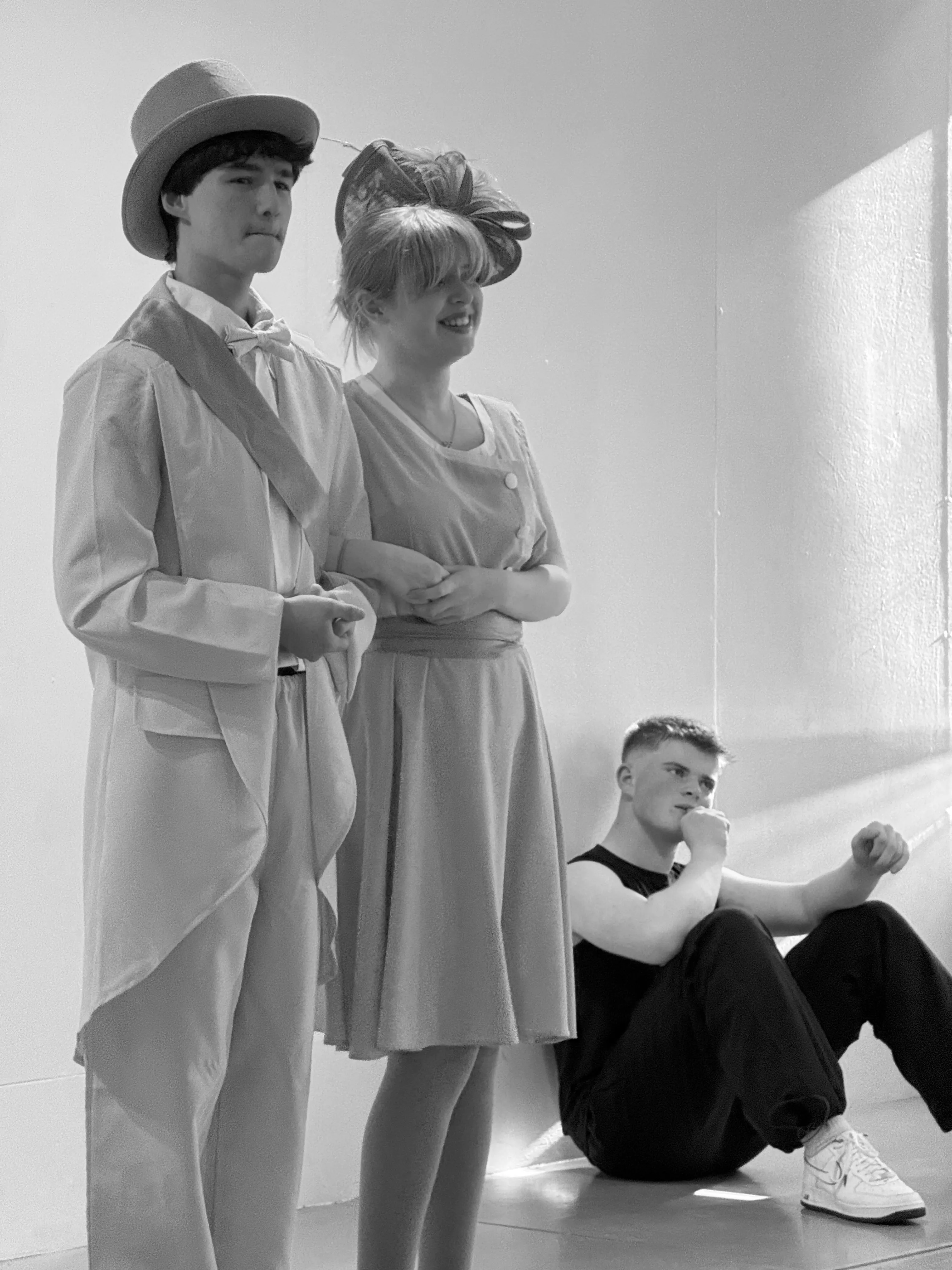
Sessions can include working with characters, scripts, scenes, storytelling and performance material, with members eventually taking what they've rehearsed into fully staged productions.
What children learn through acting
Acting isn't simply about memorising lines.
Members learn how to understand a character, communicate a story and work with other performers.
Depending on their age, experience and what they're currently working towards, acting and drama at STAMP can help members develop areas including:
- speaking and communicating clearly;
- understanding characters;
- interpreting scripts and scenes;
- listening and responding to other performers;
- storytelling;
- using voice and movement as part of a character;
- remembering dialogue, movement and cues;
- taking direction;
- working as part of an ensemble;
- performing confidently in front of other people.
Children don't need previous acting or drama experience before joining STAMP.
Drama in Minis
Minis is for children aged 3–6.
Acting is introduced in a lighter, age-appropriate way alongside singing, movement, creative play and arts and crafts.
Younger members can explore characters and stories without needing to begin with a full script or large speaking role.
As Minis prepare for performances, they can also begin working with simple performance material.
We encourage younger members to try small speaking or singing parts where appropriate, helping them gradually become more comfortable performing in front of other people.
No previous acting or performing experience is required to join Minis.
Visit the Minis class page for current session times, fees and availability.
Drama in Blue Group
Blue Group is for children aged 7–12.
Acting and drama form part of weekly sessions alongside singing, dance, movement and performance skills.
Members can work with scripts, scenes and characters and learn how acting fits into a wider musical theatre production.
When we're preparing for a show, Blue sessions may include learning scenes, developing characters, rehearsing dialogue and eventually bringing acting together with songs, choreography and staging.
For most Blue Group productions, we also hold auditions for individual roles.
Visit the Blue Group class page for current session times, fees and availability.
Drama in Green Group
Green Group is for young people aged 13+.
Acting forms an important part of Green's performance-focused musical theatre sessions alongside singing, dance, ensemble work and production rehearsals.
Older members can work more closely with scripts, scenes and character development as they prepare material for performance.
They are encouraged not only to learn dialogue, but to think about the character they're playing, what is happening in the scene and how their performance contributes to the wider production.
For most Green Group productions, members also have opportunities to audition for individual roles.
Visit the Green Group class page for current session times, fees and availability.
Acting as part of musical theatre
STAMP's regular weekly groups are musical theatre classes rather than acting-only classes.
That means acting doesn't stop when a character starts singing or dancing.
Members learn that character and storytelling continue through songs, movement and choreography.
A scene might move directly into a musical number. A character may need to sing while remaining connected to what is happening in the story. Choreography may need to be performed as the character rather than simply as a sequence of movements.
Bringing those elements together is an important part of learning musical theatre at STAMP.
Working with scripts and scenes
As members get older, scripts and scenes can become a bigger part of their work.
During production rehearsals, members may work through scenes with the director, learn dialogue and begin establishing where characters need to move on stage.
As rehearsals progress, they can work on how lines are delivered, how characters interact and how a scene connects with the rest of the production.
Eventually, those rehearsed scenes become part of the complete show.
The exact material changes depending on the production, so STAMP doesn't follow one fixed drama curriculum every week.
What if my child is shy?
A child doesn't need to be naturally outgoing to enjoy acting.
Some members are immediately comfortable speaking or performing in front of other people. Others need time to get to know the group and become familiar with how sessions work.
A quieter child can begin by participating in group and ensemble activities rather than immediately being expected to take a large individual role.
As their confidence develops, they may feel ready to volunteer for a line, try a small speaking part, perform a scene or eventually audition for a larger role.
We encourage members to challenge themselves where possible while respecting what they're comfortable with.
Read our Classes for Shy Children guide for more information.
What if my child has never acted before?
That's absolutely fine.
Beginners are welcome in STAMP's regular weekly groups.
A new member isn't expected to understand scripts, stage directions, character development or how a rehearsal works before they arrive.
These are things they can learn through taking part.
Regular weekly membership isn't audition-only, so children don't have to prove their acting ability before they can join STAMP.
Read Musical Theatre for Beginners if your child has never attended a performing arts group before.
Acting and confidence
Drama can provide lots of different opportunities for members to develop confidence.
For one child, progress might mean joining in with a group scene.
For another, it might be speaking a line clearly, volunteering for a part, performing a scene in front of the group or eventually auditioning for a principal role.
Acting also gives members opportunities to try something as a character, which can sometimes feel very different from simply being asked to stand in front of people as themselves.
We don't expect every member to develop in exactly the same way or at the same speed.
Read more about Building Confidence Through Performing Arts.
Auditions and acting roles
For most Blue and Green productions, we hold auditions for individual roles.
We see auditions as part of the learning experience.
Members are encouraged to research the show, think about the character or role they would like and prepare for their audition.
Specific roles are never guaranteed.
Not receiving a particular role doesn't mean a member isn't an important part of the production. Musical theatre depends on a complete company of performers working together.
For some members, simply deciding to audition can be an important step.
Casting for Minis is more relaxed and age appropriate, although younger members are still encouraged to try small speaking or singing parts where appropriate.
From rehearsal to performance
Productions give members the opportunity to take the acting work developed during sessions and perform it for a public audience.
Early rehearsals may concentrate on individual scenes and characters.
As the production develops, members begin connecting those scenes with other parts of the show.
They may need to remember entrances and exits, interact with scenery and props, work in costume and move between dialogue, songs and choreography while remaining in character.
Eventually, those individual rehearsals become part of a fully staged production.
Read more about Student Performance Opportunities or see our current productions.
Who teaches acting at STAMP?
Acting and drama are delivered by members of STAMP's wider teaching and creative teams.
Green Group's current teaching team includes Harvey Johnson as Director and Acting Coach.
Harvey's background includes work as an actor, director and arts educator, and he has a long connection with STAMP having previously been a member himself.
Other members of the STAMP teaching and production teams also contribute to acting, directing and performance work across our groups and productions where appropriate.
You can read current roles and biographies in our Team Directory.
Does STAMP offer drama exams?
STAMP's regular weekly groups are not advertised as graded drama examination classes.
Our focus is musical theatre, rehearsals, productions and live performance.
If you're specifically looking for a programme focused entirely on graded drama examinations, screen acting or an acting-only curriculum, STAMP's regular groups may not be the type of class you're looking for.
If your child wants to act while also developing singing, dancing and wider musical theatre performance skills, STAMP may be a good fit.
Drama classes in South Shields
STAMP has provided performing arts opportunities for children and young people in South Tyneside since 2006.
Our regular weekly musical theatre classes take place at:
STAMP Studios
5 Frederick Street
South Shields
Tyne and Wear
NE33 5DY
Our three regular groups are:
- Minis: ages 3–6
- Blue Group: ages 7–12
- Green Group: ages 13+
All three include acting and drama alongside other areas of musical theatre.
Current session times, fees and availability are available through our Classes page.
Is STAMP right for a child who loves acting?
If your child enjoys acting, characters, stories or performing and would also like opportunities to sing, dance and take part in musical theatre productions, STAMP may be a good fit.
They don't need previous acting experience to get started.
Some members discover that acting is the part of musical theatre they enjoy most. Others arrive interested in singing or dancing and develop an interest in acting after joining.
Our regular classes give members opportunities to experience all three disciplines and discover where their interests and strengths develop.
Explore Minis, Blue Group and Green Group to find the appropriate group and check current availability.
Continue exploring
Related parent guides
Building Confidence Through Performing Arts
How confidence can grow through specific performing arts experiences, without promising that every child will change in the same way.
Children’s Musical Theatre Classes in South Tyneside
What to compare when looking for a children’s theatre school, and how STAMP’s three weekly groups currently fit together.
Classes for Shy Children
A realistic guide for parents whose child wants to perform but feels nervous about new people, being watched or getting things wrong.